 English
 English


IgG antibodies and the “immune gap” in young children.
The immune system is a complex defense network that plays a fundamental role in ensuring healthy growth and development in young children. However, during the early years of life, particularly when children begin interacting more actively with the external environment, this system is frequently exposed to significant challenges.
IgG is the most abundant antibody found in the blood and body fluids, functioning as a core line of defense and representing long-term immunity as well as immune memory. It is a key component of passive immunity, transferred from mother to child through the placenta. However, due to natural physiological processes, maternal IgG levels decline rapidly after birth. This decrease, combined with the child’s still-limited ability to produce endogenous antibodies, creates a temporary vulnerability in the immune system known scientifically as the “immunity gap.”

IgG antibodies – A crucial factor in immune protection in children
IgG antibodies – Protecting shield in the immune system of children
To establish appropriate defense strategies for children, it is essential to understand the role of IgG antibodies within the humoral immune system.
What are IgG antibodies?
The body’s humoral immune system is built upon five main classes of antibodies (Immunoglobulins – Ig), including IgG, IgA, IgM, IgE, and IgD. Each class performs a distinct and specialized function. Among them, IgG is the most abundant antibody in the blood and body fluids, serving as a central line of defense and representing long-term immunity as well as immune memor.
IgG is defined as the primary immune protein, accounting for approximately 75–80% of the total antibody pool. It is also the smallest antibody molecule among all classes, a biological characteristic that enables it to readily penetrate tissues and capillaries, thereby protecting extravascular spaces where pathogens commonly reside. While IgM acts as the first responder during initial immune reactions and IgA primarily safeguards mucosal surfaces, IgG plays a decisive role in sustaining long-term protection and establishing immune memory.

IgG – The main immune protein, accounting for approximately 75-80% of total antibodies.
3 protective mechanisms of IgG antibodies
IgG antibodies protect the body through three primary biological mechanisms, demonstrating remarkable versatility and effectiveness in combating pathogens:
– Neutralization mechanism: IgG binds tightly to surface antigens of viruses or toxins. This binding prevents viruses from attaching to target cells and blocks toxins from damaging tissues. It acts as a first-line defense, neutralizing the infectivity of pathogens before they can invad.
– Opsonization mechanism: IgG coats pathogens, generating a strong recognition signal known as an opsonin. This signal enables immune cells, primarily macrophages and neutrophils to readily identify, capture, and eliminate the target. Opsonization significantly enhances both the efficiency and speed of phagocytosis.
– Passive immunity and transplacental transfer: IgG is the only antibody class equipped with receptors that allow active transport across the placental barrier. This unique capability provides passive immune protection to the fetus and newborn during the early months of life, before the child’s immune system fully matures and produces sufficient antibodies.
“Immune gap” in children
Although maternal IgG provides an initial protective barrier, it is not a permanent source of support. Understanding the mechanisms behind the formation of an “immune gap” is crucial to determining when a child needs the most support.
Mechanism of gap formation: Decreased maternal immunity passed on to the child
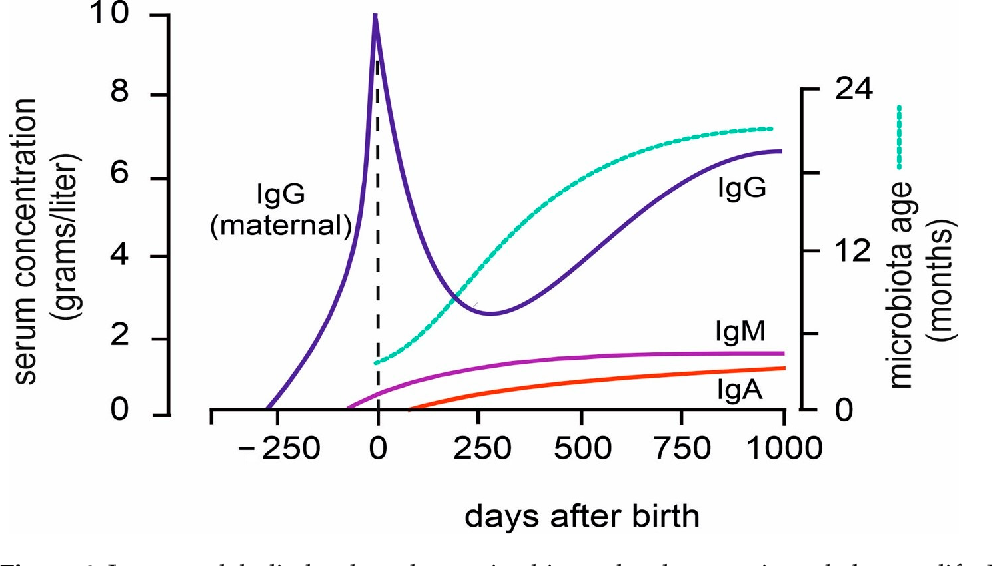
The immunity gap occurs when the concentration of IgG transmitted from mother to child decreases after 6 months
The “immunity gap” arises from the natural physiological decline of maternally transferred antibodies. An examination of the transplacental transfer of IgG and its subsequent decrease over time shows that maternal IgG has a half-life of approximately 21–28 days. The half-life refers to the time required for the antibody concentration in the blood to reduce by half. This means that passive antibody levels decrease by 50% every 3–4 weeks, leading to a rapid depletion.
Around 6 months of age is considered the most critical period for a child’s immune system. At this stage, serum IgG levels reach their lowest point, creating a window during which the child has minimal passive immune protection.
Weak immune system
The deficiency of maternally derived antibodies is further exacerbated by the immaturity of the child’s immune system. B cells, responsible for antibody production, and T cells, which mediate cellular immunity, in infants and young children are still undergoing development and functional training, reaching optimal IgG production only after several years.
The deficiency of maternally derived antibodies is further exacerbated by the immaturity of the child’s immune system. B cells, responsible for antibody production, and T cells, which mediate cellular immunity, in infants and young children are still undergoing development and functional training, reaching optimal IgG production only after several years.
This dual limitation leads to clear clinical consequences, including an increased risk of respiratory and gastrointestinal infections, as well as impaired growth. Insufficient IgG levels directly contribute to recurrent infections, growth delays due to illness, and prolonged malabsorption.
Gap-filling strategy: The role of exogenous IgG
Based on the pathophysiological mechanism of the “immune gap,” supplementing exogenous IgG through nutrition is a proactive and effective intervention strategy.
Why is it necessary to supplement exogenous IgG in the immune gap?

Supplementing with exogenous IgG helps to strengthen the immune system during periods of deficiency
An exogenous IgG supplementation strategy represents a proactive nutritional intervention designed to directly address antibody deficiency during periods of immune immaturity in children. The objectives of this approach include:
– Establishing a temporary “immune bridge”: The biological goal of exogenous IgG supplementation is to create a stable immune bridge, providing immediate protection while the child’s endogenous immune system gradually develops the capacity to produce antibodies at optimal levels.
– Supporting passive immunity: Unlike vaccines, which require time to stimulate an active immune response, exogenous IgG delivers functional antibodies instantly. This is particularly important for neutralizing common pathogens encountered in the community.
– Strengthening overall immune defense: Supplementation with external IgG sources has been shown to reinforce the body’s defense mechanisms, directly reducing both the frequency and severity of respiratory and gastrointestinal infections. This serves as a strategic measure to safeguard children during the most critical stages of immune system development.
Colostrum: A scientifically proven source of exogenous IgG
To identify an optimal source of exogenous antibodies, nutritional science has focused on the study of colostrum. This is the initial secretion from the mammary glands within the first 72 hours after birth and is often referred to as the “first natural vaccine” due to its exceptionally high content of proteins, growth factors, and especially IgG antibodies compared to mature milk.
In pediatric applications, bovine colostrum is preferred because its antibody structure shows a high level of compatibility with humans. It contains significantly higher concentrations of IgG, typically 50 to 100 times greater than regular milk, making it a valuable source for antibody supplementation.
To ensure maximum biological efficacy, stringent quality standards must be applied. IgG should be harvested from colostrum within the first 24 hours postpartum and standardized to accurately determine the concentration of active antibodies in the final product. This guarantees that each serving delivers a scientifically validated level of immune protection.
Clinical studies on the efficacy of IgG supplementation
Clinical studies have provided robust evidence supporting the benefits of exogenous IgG supplementation, particularly in enhancing local immune defense. Systematic reviews have demonstrated a positive association between the use of IgG-rich colostrum and a significant reduction in the incidence of upper respiratory tract infections and diarrhea in children, while also strengthening intestinal mucosal immunity during the “immunity gap.” Exogenous IgG contributes to reinforcing the protective barrier in children, minimizing the impact of common pathogens and promoting faster recovery during illness.
In practice, ensuring that young children receive adequate levels of antibodies and immune-supporting micronutrients through a regular diet remains a challenge, especially during the “immunity gap.” To address this critical nutritional shortfall, Medical Nutrition solutions have been researched and developed as an effective supportive approach.
Metacare Colostrum 2+ is a nutritional product developed by experts from Nutricare in collaboration with the Nutricare Medical Nutrition Institute – USA (NMNI-USA), applying advanced nutritional science to deliver an appropriate supplementation solution for young children.
The nutritional formulation of Metacare Colostrum (collectively referred to as “Metacare Colostrum”) is designed around key developmental pillars aimed at bridging the “immunity gap” and promoting comprehensive growth in children, including:
– Immune enhancement: Metacare Colostrum contains a high concentration of IgG antibodies derived from U.S. colostrum, an antibody class proven to play a central role in humoral immunity. IgG is capable of recognizing, binding to, and neutralizing viruses, bacteria, and toxins, enabling the child’s body to respond promptly to invading pathogens. This function is particularly critical during periods when the immune system is not yet fully developed.
– Optimizing digestive health and nutrient absorption: Metacare Colostrum features a formulation with 30 billion Postbiotics, combined with HMOs and dietary fiber, to promote a healthy digestive system and maximize nutrient absorption.
– Comprehensive nutritional support for growth: The product is enriched with high-quality protein and essential amino acids such as lysine, which help stimulate appetite, enhance energy metabolism, and support healthy weight gain. Additionally, the combination of Calcium, Vitamin K2, and Vitamin D3 contributes to building strong bones and promoting optimal height development.
With its comprehensive formulation, Metacare Colostrum serves as a rational and scientifically developed nutritional solution that effectively supports children in bridging the “immunity gap,” while establishing a strong foundation for outstanding physical and cognitive development.
Conclusion
IgG antibodies play a central role in a child’s immune defense, particularly through passive immunity transferred from the mother. However, the emergence of the “immunity gap” from the middle of the first year of life and extending into the following years is an unavoidable physiological reality, leaving children more vulnerable to infectious diseases and potentially impacting their growth and development. To optimize immune development in children, it is essential to integrate scientific understanding of IgG antibodies and the immunity gap into nutritional practices. This approach not only supports children in safely navigating this critical period but also helps establish a strong foundation for the maturation of their own immune system in the future.
References:
|
Maybe you are interested
Nutrition during and after cancer treatment
Nutrition before, during and after cancer treatment not only helps improve health status but also plays an important role in...
See more
ESPGHAN/ESPEN/ESPR guidelines on pediatric parenteral nutrition: Energy
Methods Medline search, Pub-Med search. Timeframe: publications from 2004 to 2016 were used to update the previous recommendations from 2005....
See more
Frailty syndrome in older adults and nutritional interventions
[caption id="attachment_3585" align="alignnone" width="1536"] Frailty syndrome is common in adults over 75[/caption] Unintentional weight loss, persistent fatigue, and slowed mobility...
See more